
If your company wants to use HRD Corp levy funds for training in 2026, the most important rule is simple: prepare the documents early and submit the grant application before the training begins.
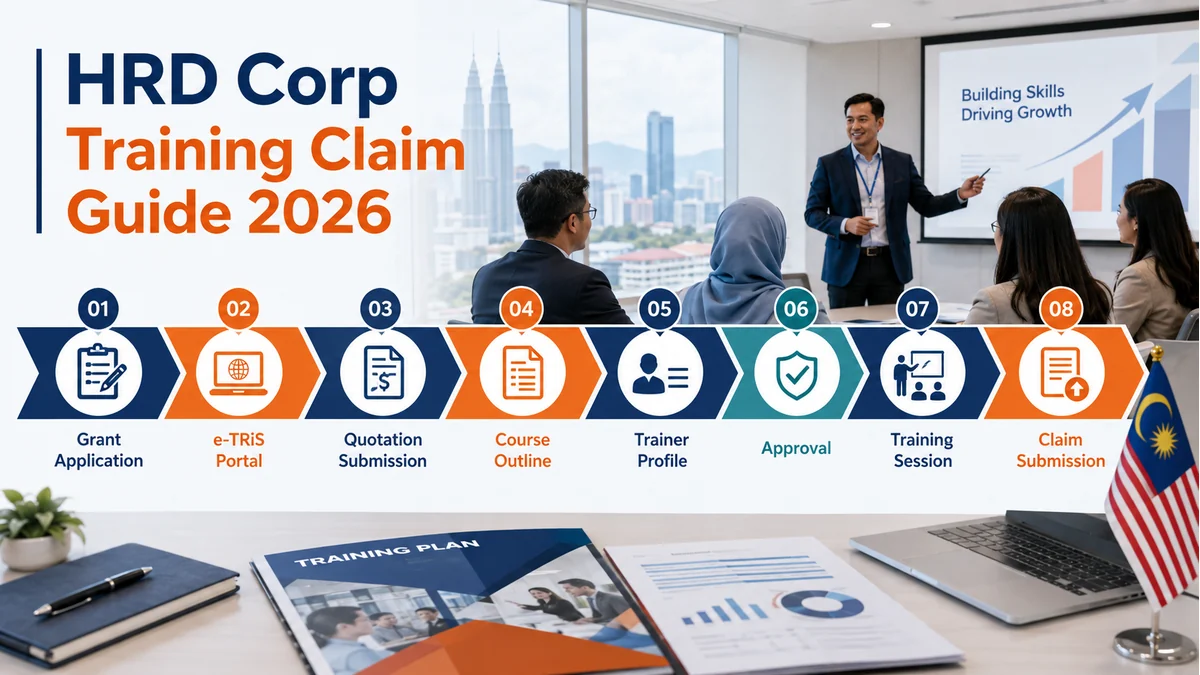
This guide walks Malaysian employers through the practical sequence: grant application, e-TRiS, quotation, course outline, trainer profile, approval, training delivery, and claim submission. It is written for HR teams, training managers, finance teams, and business owners who want fewer back-and-forth queries when preparing HRD Corp claimable training.
Quick Answer: How Do Employers Claim HRD Corp Training In 2026?
To claim HRD Corp training in 2026, an eligible employer should first choose a suitable HRD Corp claimable programme, collect the provider’s supporting documents, submit the training grant application through e-TRiS before training starts, wait for approval, conduct the approved training, then submit the claim with the required proof after completion.
HRD Corp states that supporting information for applications may include documents such as a quotation or invoice, training schedule or course content, and trainer profile. These details should match the employer’s grant application, attendance records, invoice, and final claim documents.
For a broader overview of claimable courses and timing rules, you can also read Wonder Academy’s HRD Corp claimable courses guide for Malaysian employers.
Before You Start: Confirm Employer Eligibility
HRD Corp training claims are mainly relevant to employers registered with HRD Corp under Malaysia’s human resources development framework. Before selecting a date or asking a provider to reserve seats, check that your company registration, levy position, employer profile, and user access in e-TRiS are in order.
This matters because a training provider can supply the course documents, but the employer remains responsible for the grant application and claim submission. If there are issues with levy balance, employer registration, participant eligibility, incomplete information, or mismatched documents, approval and claim processing can be delayed.
The 2026 Employer Flow At A Glance
- Grant application: Decide the training need, participant group, preferred format, estimated cost, and intended date.
- e-TRiS: Log in to e-TRiS and prepare the application before training begins.
- Quotation: Get the provider’s quotation or invoice with clear course fee, date, duration, venue or delivery mode, and participant information where applicable.
- Course outline: Attach the training schedule, learning outcomes, course content, and programme details.
- Trainer profile: Include the trainer profile or trainer information required for the application.
- Approval: Wait for grant approval and respond quickly if HRD Corp asks for clarification.
- Training: Conduct the training according to the approved dates, participants, and format.
- Claim: Submit the claim with the required post-training documents and proof within the required timeframe.
Step 1: Decide The Training Need And Format
Start with the business need, not the form. A useful training plan should answer what capability gap you are trying to close, who should attend, how urgent the training is, and whether the best format is public training or in-house training.
Public programmes are usually easier when only one or a few employees need a specific topic, such as leadership, communication, digital productivity, AI tools, customer service, sales, compliance, or first aid. In-house training is usually better when you want to train a larger internal group, customise case studies, or align the programme with company-specific SOPs and KPIs.
For HRD Corp purposes, keep the selected training outcome practical and documentable. The course title, training objectives, duration, trainer, provider, participant list, and fees should be clear enough for both internal approval and HRD Corp review.
Step 2: Request A Complete Quotation Or Invoice
The quotation is often the first document HR or finance asks for, but it should not stand alone. Ask the training provider to include or provide separately the course title, course fee, dates, duration, delivery mode, venue if relevant, participant count, provider details, and payment information.
If travel, transport, meals, accommodation, or other allowable costs are involved, check HRD Corp’s latest allowable-cost requirements before assuming they can be claimed. Keep these items separated clearly so your finance team can match the quotation, invoice, receipts, and claim submission later.
Step 3: Prepare The Course Outline And Schedule
HRD Corp guidance refers to training schedule or course content as supporting information. In practice, employers should request a clean course outline that includes learning objectives, modules, agenda, training hours, methodology, assessment or activity approach if applicable, and expected outcomes.
A strong course outline helps the employer justify the grant application. It also reduces ambiguity if the course title is broad. For example, “leadership training” can mean many things, but a proper outline can show whether the programme covers communication, delegation, coaching, performance conversations, problem solving, decision-making, or strategic planning.
Step 4: Get The Trainer Profile
HRD Corp also identifies the trainer profile as common supporting information. The trainer profile should show the trainer’s name, relevant experience, subject-matter expertise, credentials where applicable, and suitability for the programme.
Employers should check that the trainer profile matches the training being applied for. A mismatch between trainer expertise and course topic can raise questions internally or during grant review. If the provider later changes trainer, ask for the updated profile and keep the document trail clear.
Step 5: Submit The Grant Application Through e-TRiS Before Training Begins
Do not wait until the day before the programme. HRD Corp confirms that employers should apply before training begins, and grant approval should be secured before training is conducted. The e-TRiS submission is where the employer enters the training details and attaches the supporting information.
Before submission, check these items:
- The employer profile and HRD Corp access are active.
- The selected provider and programme details are correct.
- The training date, time, duration, venue or online mode are consistent.
- The quotation amount matches the application amount.
- The course outline and trainer profile are attached.
- The participant details are accurate and internally approved.
Once submitted, monitor e-TRiS for approval status or queries. If HRD Corp asks for clarification, answer promptly and keep the provider informed if training dates might be affected.
Step 6: Wait For Approval Before Conducting Training
This is where many avoidable problems happen. A course may be useful, the provider may be ready, and the participants may be available, but employers should not treat those factors as grant approval. Wait for the official approval before running the training.
In 2026, also pay attention to HRD Corp’s current training commencement rules, especially if you are choosing between public and in-house training. The timing rules can change, so always check the official HRD Corp page or support centre before locking dates.
Step 7: Run The Training And Keep Evidence
During the training, make sure the records are complete. Attendance, trainer confirmation, programme materials, evaluation forms, certificates, photos if required by your internal process, and other proof should be stored neatly. The point is not to create paperwork for its own sake. It is to make the claim stage easier for HR, finance, management, and the training provider.
If the approved date, venue, trainer, participant list, or training format changes, check what needs to be updated before proceeding. Do not assume small changes are administratively harmless.
Step 8: Submit The Claim After Completion
After training, prepare the claim based on HRD Corp’s requirements and your approved grant details. Common claim documents may include the final invoice, proof of payment where applicable, attendance records, receipts for approved cost items, completion proof, and any documents specified in the approval or HRD Corp guidance.
Match the claim against the approved grant. If the quotation said one date and the attendance form shows another, or if the participant count changed, reconcile the records before submitting. Claims become easier when every document tells the same story.
Common Mistakes Employers Should Avoid
- Starting training before approval. Submit and secure approval before the programme begins.
- Using incomplete documents. The quotation, course outline, schedule, and trainer profile should be ready before submission.
- Mixing public and in-house assumptions. Rules and supporting information can differ depending on training format.
- Ignoring e-TRiS queries. A delayed response can affect the training timeline.
- Changing details without updating records. Trainer, date, participant, venue, and fee changes should be managed properly.
- Waiting too long after training. Keep claim documents ready as soon as the programme ends.
What To Ask A Training Provider Before You Apply
Before confirming HRD Corp claimable training, ask the provider these practical questions:
- Can you provide the quotation or invoice, course outline, training schedule, and trainer profile?
- Is this programme intended for public training or in-house training?
- What dates and delivery mode are available?
- What is included in the quoted fee?
- What information should we prepare before submitting in e-TRiS?
- Who can assist if HRD Corp asks for clarification on the programme?
These questions help employers compare providers fairly. They also reveal whether the provider understands the documentation rhythm behind HRD Corp claimable training.
FAQs About HRD Corp Training Claims In 2026
Can employers apply after the training has started?
Employers should apply for the training grant before the training begins. Treat this as a core planning rule and confirm the latest requirements directly with HRD Corp or e-TRiS before the programme date.
What documents should employers prepare for the grant application?
Common supporting information includes the quotation or invoice, training schedule or course content, and trainer profile. Additional documents may be needed depending on the training type, cost items, and claim category.
Does a claimable course guarantee approval?
No. Approval depends on HRD Corp requirements, employer eligibility, levy and grant conditions, programme details, and complete supporting documents.
Who submits the application in e-TRiS?
The employer normally handles the e-TRiS application. The training provider supports the process by supplying programme documents, quotation details, trainer profile, and related training information.
Should employers keep separate claim files?
Yes. Keep a simple digital folder for each training programme with the quotation, approval, course outline, trainer profile, attendance, invoice, payment proof where applicable, and claim submission records.
Final Checklist For Employers
- Confirm HRD Corp registration, levy status, and e-TRiS access.
- Choose the training topic, provider, format, date, and participants.
- Collect the quotation or invoice, course outline, schedule, and trainer profile.
- Submit the grant application before training begins.
- Wait for approval and resolve queries before the programme date.
- Run the training according to the approved details.
- Keep attendance, invoices, receipts, and completion evidence.
- Submit the claim with consistent supporting documents.
Looking For HRD Corp Claimable Training?
If you are planning training for Malaysian employees in 2026, start with the business outcome, then prepare the documents before choosing the final date. The cleaner your quotation, course outline, trainer profile, and e-TRiS submission are, the smoother the grant and claim process usually becomes.
Looking for HRD Corp claimable training? Explore Wonder Academy programmes.
Sources checked: HRD Corp Claimable Courses, HRD Corp support centre guide, HRD Corp FAQ, and HRD Corp training providers page.