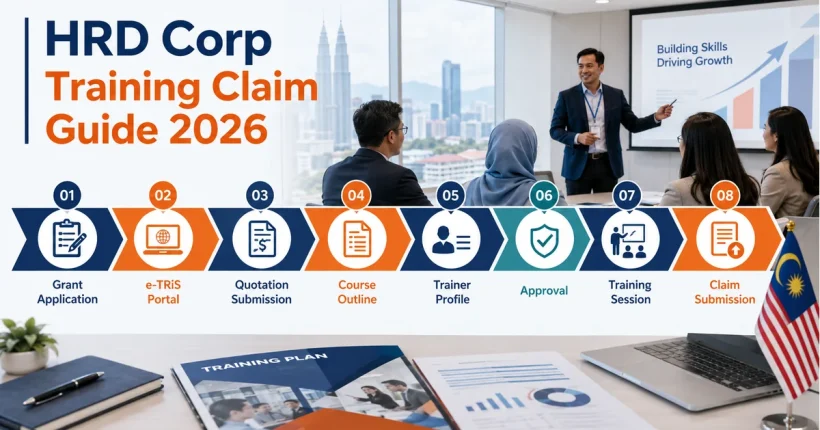

If your company plans to use HRD Corp levy funds for training in 2026, the biggest thing to watch is not just which course to choose. It is the timing of your grant approval.
HRD Corp claimable courses remain one of the most useful ways for Malaysian employers to retrain and upskill employees, but the rules around when training can start after grant approval are especially important in 2026. Public training has a temporary shorter window from 15 June to 31 December 2026, before the requirement returns to a longer rule from 1 January 2027.
This guide explains what HRD Corp claimable courses are, what employers should prepare, how the 2026 public-training window works, and how to reduce avoidable delays before sending staff for training.
Quick Answer: What Employers Need To Know In 2026
HRD Corp Claimable Courses are training programmes that help registered Malaysian employers retrain and upskill employees according to business needs. According to HRD Corp, support can cover in-house or public training with a minimum duration of four hours, plus allowable related costs such as meal allowance, daily allowance, consumable training materials, venue or hotel rental package, airfare, or transportation, subject to the Allowable Cost Matrix.
The key 2026 timing rule is this: effective 15 June 2026, in-house training can be conducted 14 days after grant approval. Public training can be conducted three days after grant approval from 15 June to 31 December 2026. From 1 January 2027, public training returns to the 14-day rule, aligned with in-house training.
For employers, that means the second half of 2026 is a useful window to plan public programmes faster, while still giving enough time for e-TRiS submission, queries, approval, internal purchase orders, participant nomination, and documentation.
What Are HRD Corp Claimable Courses?
HRD Corp Claimable Courses are designed to support employers in retraining and upskilling employees in line with operational and business requirements. In simple terms, eligible registered employers can apply for training grants through HRD Corp, attend approved training, and submit claims according to HRD Corp rules.
For many Malaysian employers, this is how training budgets become more practical. Instead of treating learning and development as a nice-to-have expense, HR teams can connect training to levy utilisation, workforce capability, productivity, leadership development, compliance, digital transformation, and succession planning.
However, HRD claimable course Malaysia searches often miss one important point: a course being advertised as claimable does not automatically mean every employer, participant, date, cost, or claim will be approved. Employers still need to follow HRD Corp requirements, submit the right documents, and ensure their levy account and grant application are in order.
Who Can Use HRD Corp Training In Malaysia?
HRD Corp training Malaysia is mainly relevant to employers covered under the Pembangunan Sumber Manusia Berhad Act 2001. HRD Corp’s employer FAQ states that companies with a minimum of 10 Malaysian employees are required to register if they fall within covered sectors, while companies with five to nine Malaysian employees may register optionally.
Once registered, employers pay the HRD levy. HRD Corp states that the mandatory category is 1% of monthly wages plus fixed allowances, while the optional category is 0.5%. By paying the levy, employers can access financial assistance through the levy or grant system to train and develop Malaysian employees.
If your organisation is unsure whether it is registered, whether its industry is covered, or whether there are outstanding levy or interest issues, check directly through HRD Corp or e-TRiS before confirming training dates with any provider.
What Changed For HRD Corp Courses In 2026?
The timing rule is the main reason employers should pay attention now. HRD Corp’s Claimable Courses page lists the following 2026 notice for training commencement after grant approval:
- In-house training: effective 15 June 2026, programmes can be conducted 14 days after grant approval.
- Public training: programmes can be conducted three days after grant approval from 15 June to 31 December 2026.
- From 1 January 2027: public training returns to the 14-day requirement, aligned with in-house training.
- Commencement window: approved training must start within 90 calendar days after the applicable advance-approval requirement.
- Claim deadline: training claims must be submitted within six months from the training completion date.
This creates a practical planning advantage for public training in the second half of 2026. If your team only has one or a few employees to train, public programmes may be easier to schedule before the 2027 change. For larger teams, customised in-house training may still make more sense, but you should plan around the 14-day post-approval requirement.
Public Training Vs In-House Training: Which Should Employers Choose?
HRDC claimable training can be delivered in different formats, and the right option depends on your headcount, learning objectives, urgency, and budget.
Public Training
Public training is usually suitable when you have a small number of employees attending an open programme. HRD Corp’s support centre guidance lists public training as covering a minimum of one participant and a maximum of nine participants. It can be useful for managers, executives, or specialists who need exposure to external participants and broader case discussions.
For 2026, public training is also attractive because of the temporary three-day post-approval commencement rule from 15 June to 31 December 2026. That does not mean employers should submit late. It simply means there may be more scheduling flexibility after approval is granted.
In-House Training
In-house training is usually better when you want to train a larger group from the same organisation, tailor examples to your operations, or align the workshop with internal goals. HRD Corp’s support centre guidance lists in-house training for a minimum of two participants and a maximum of 50 participants.
The trade-off is planning time. Since in-house training can be conducted 14 days after grant approval, HR teams should build a timeline that includes internal approval, provider quotation, document preparation, grant submission, possible queries, approval, and participant coordination.
What Costs And Documents Are Usually Involved?
For the HRD Corp Claimable Courses scheme, HRD Corp lists course fee, meal allowance, trainee allowance, consumable training materials, airfare or transportation, and remote-online internet data cost up to RM100 per group among claimable items, with other expenses subject to the Allowable Cost Matrix.
For the application process, HRD Corp’s Claimable Courses page and support centre guidance point employers to e-TRiS and commonly required supporting documents such as:
- Quotation or invoice
- Training schedule or course content
- Trainer profile
- Transportation quotation or invoice, if applicable
- Travel itinerary and receipts, if applicable at claim stage
Employers should keep these documents consistent. The course title, dates, participant list, training type, location, fee, and provider information should match across the quotation, schedule, grant application, attendance records, invoice, and claim documents. Small inconsistencies can create avoidable queries.
Why The HRD Corp Registered Training Provider Status Matters
HRD Corp’s support centre states that HRD Corp Claimable Courses are applicable only for training by a registered training provider, and programmes conducted under the scheme must be registered with HRD Corp. HRD Corp also explains that registered training providers act as training vendors to HRD Corp registered employers.
In practice, employers should confirm three things before committing to a training date:
- The training provider is properly registered with HRD Corp.
- The programme is registered or eligible under the relevant HRD Corp scheme.
- The provider can supply the quotation, schedule, course content, and trainer profile needed for the grant application.
Wonder Academy positions its programmes around practical, HRD Corp claimable training for Malaysian organisations. Employers comparing providers should still confirm programme-specific details, fees, dates, trainer profiles, and claim documents before submitting the grant application.
How Employers Can Plan Before The 2027 Rule Change
The 2026 public-training window is useful, but it should not encourage rushed administration. A good employer timeline works backwards from the intended training date.
- Shortlist the learning need. Decide whether the priority is leadership, productivity, compliance, sales, digital tools, AI, operations, communication, or another capability gap.
- Choose the training format. Use public training for smaller numbers or faster external exposure; use in-house training when customisation and team alignment matter more.
- Confirm provider and programme details. Request the quotation, schedule, course outline, trainer profile, venue details, and HRD Corp-related documentation.
- Submit the grant application early. Do not treat the three-day public-training window as a submission deadline. Queries, weekends, holidays, internal approvals, and document corrections can still affect timing.
- Wait for grant approval before training. HRD Corp guidance requires grant application and approval before training begins.
- Track post-training claim documents. Keep attendance, invoices, receipts, evaluation forms, certificates, and any required proof ready for claim submission within the six-month window.
For example, an employer sending two managers to a public leadership programme in November 2026 may benefit from the temporary three-day rule after approval. But if the same employer plans a customised workshop for 30 supervisors, the in-house 14-day rule applies, and the planning timeline should be longer.
Common Mistakes To Avoid
- Assuming claimable means guaranteed approval. HRD Corp approval is subject to the employer’s eligibility, levy position, programme details, and supporting documents.
- Submitting too close to the training date. The 2026 public-training window helps after approval, but it does not remove the need for complete application documents.
- Mixing up public and in-house rules. Public training has the temporary three-day window until 31 December 2026; in-house training follows the 14-day requirement from 15 June 2026.
- Using inconsistent documents. Course names, dates, fees, trainer names, and participant details should match across all submission and claim records.
- Forgetting the claim deadline. HRD Corp states that training claims must be submitted within six months from completion.
- Planning 2027 public training like 2026 public training. From 1 January 2027, public training returns to the 14-day requirement.
Example: Leadership Training For Malaysian Employers
Leadership training is a common HRD Corp training Malaysia use case because it connects directly to productivity, communication, succession planning, and business performance. Wonder Academy’s Effective Leadership Skills course is positioned for heads of departments, senior management, directors, and C-Suite leaders, with a two-day in-person format and HRD Corp claimable price shown on the course page.
The related public event page lists programme details, venue, dates, price, capacity, trainer, and HRD Corp training programme number. These are exactly the kinds of details an employer should align with the grant application and internal training plan.
As always, employers should confirm the latest availability, pricing, dates, and HRD Corp documentation directly before submission. Wonder Academy’s terms also make clear that HRD Corp claim approval is subject to HRD Corp policies and employer eligibility.
Practical Employer Checklist
- Confirm your organisation’s HRD Corp registration and levy position.
- Define the business outcome you want from training.
- Decide whether public or in-house training fits better.
- Check the applicable 2026 or 2027 commencement rule before selecting dates.
- Request the quotation, trainer profile, course content, and schedule early.
- Submit the grant application through e-TRiS before the training date.
- Do not begin training until grant approval is received.
- Keep all attendance, invoice, receipt, and completion records for claims.
- Submit the claim within HRD Corp’s required timeframe.
FAQs About HRD Corp Claimable Courses
Are HRD Corp claimable courses automatically approved?
No. Employers should apply for training grant approval through HRD Corp before training begins. Approval depends on the employer’s eligibility, levy position, programme details, documents, and HRD Corp’s requirements.
Can public training start three days after approval in 2026?
Yes, HRD Corp states that public training programmes can be conducted three days after grant approval from 15 June to 31 December 2026. From 1 January 2027, public training returns to the 14-day rule.
Does in-house training also get the three-day 2026 window?
No. HRD Corp states that effective 15 June 2026, in-house training programmes can be conducted 14 days after grant approval.
What documents do employers usually need?
Common documents include a quotation or invoice, training schedule or course content, and trainer profile. Additional documents may be required depending on training type, cost items, travel, transportation, and HRD Corp verification needs.
Is Wonder Academy an HRD Corp registered training provider?
Wonder Academy’s website identifies Wonder Innovation Hub Sdn Bhd as an HRD Corp Registered Training Provider and lists HRD Corp claimable programmes. Employers should still confirm the specific programme details and supporting documents before each grant application.
Final Thoughts
HRD Corp courses 2026 planning is really about timing, documentation, and choosing training that produces business value. The temporary public-training rule from 15 June to 31 December 2026 gives employers more flexibility after grant approval, but it does not remove the need for proper submission and approval through HRD Corp.
If your organisation is planning HRD Corp claimable courses for managers, executives, teams, or technical staff, start with the learning need, confirm the right training format, and prepare the grant documents early. Wonder Academy can support Malaysian employers with practical training programmes and the documentation needed to plan a smoother HRD Corp training application.
Sources checked: HRD Corp Claimable Courses, HRD Corp Claimable Courses support centre guide, HRD Corp Employers FAQ, PSMB Act 2001 page, HRD Corp Circulars, and HRD Corp Training Providers.