
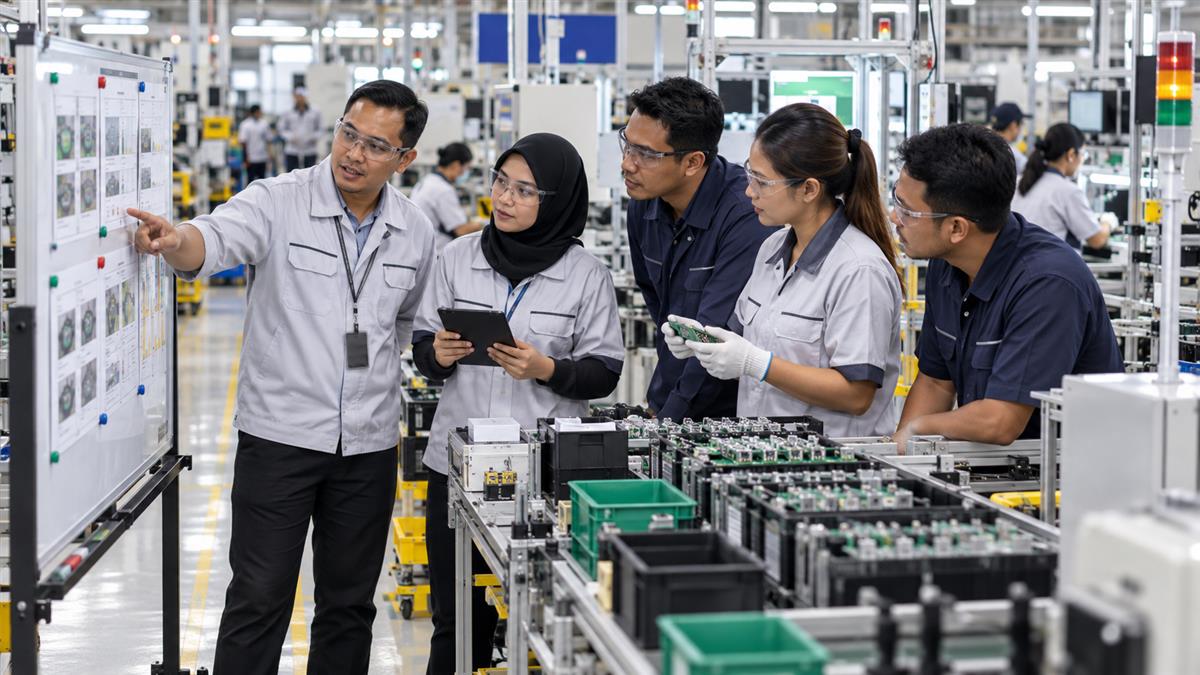
Kaizen is a practical approach to continuous improvement. Instead of waiting for one major transformation project, teams make small, disciplined changes to the way work is done, measure the result, and build successful improvements into the standard process.
For Malaysian manufacturers, Kaizen can help turn recurring problems such as rework, long changeovers, excess movement, waiting time and inconsistent work methods into structured improvement opportunities. This guide explains what Kaizen means, how it relates to Lean manufacturing, and how a team can start reducing manufacturing waste on the shop floor.
Quick answer: What is Kaizen?
Kaizen is a Japanese term commonly translated as “change for the better” or “continuous improvement”. In manufacturing, it means involving the people closest to the process in a steady cycle of finding problems, testing practical countermeasures, checking the results and standardising what works.
Kaizen is not simply asking employees to work faster. It is a way to improve the process so that work becomes safer, more consistent, less wasteful and easier to perform. The Lean Enterprise Institute describes continuous improvement, or Kaizen, as small, incremental changes to processes, systems and activities.
How Kaizen fits into Lean manufacturing
Lean manufacturing is the broader management approach for creating value with less waste. Kaizen is one of the behaviours and improvement methods that makes Lean practical at process level. A Lean programme may involve value-stream thinking, flow, pull, standard work, visual management and problem-solving. Kaizen turns those ideas into repeated action by teams.
This is why Kaizen should not be treated as a one-off “clean-up day”. A successful improvement may begin with a focused Kaizen event, but the long-term benefit comes from daily follow-up, clear ownership and a new standard that people can actually use.
The approach also has a strong connection with the Toyota Production System. Toyota explains its production system through the pursuit of waste elimination, shorter lead times, built-in quality and daily incremental Kaizen. The lesson for other manufacturers is not to copy a factory mechanically, but to develop a disciplined way of seeing problems and improving the work.
The eight wastes Kaizen helps manufacturers find
Waste is any activity that consumes resources without adding value for the customer. A Kaizen team often uses the eight-waste model as a practical observation guide. The categories are sometimes remembered with the acronym TIMWOODS:
- Transport: unnecessary movement of materials, components or finished goods between locations.
- Inventory: excess raw material, work-in-progress or finished stock that ties up cash and can hide process problems.
- Motion: avoidable walking, reaching, bending, searching or handling by employees.
- Waiting: time lost while people, machines, information, tools, approvals or materials are unavailable.
- Overproduction: making earlier, faster or in greater quantity than the next process or customer requires.
- Overprocessing: extra steps, inspections, features or handling that do not improve the product for the customer.
- Defects: errors that lead to scrap, rework, complaints, returns or additional inspection.
- Unused talent: failing to use the knowledge, ideas and problem-solving ability of the people doing the work.
These categories are not a checklist to complete from a desk. The useful question is: “Where does this waste happen in our actual process, how often does it happen, and what condition allows it to continue?”
How Kaizen reduces waste and improves productivity
Kaizen improves productivity by removing obstacles from the process, not by simply pressuring people to produce more. For example, a team may discover that operators spend several minutes searching for a gauge at the start of every batch. A shadow board, point-of-use storage and a simple replenishment rule may reduce motion and waiting without purchasing new equipment.
Other practical examples include:
- Rearranging tools and materials to reduce walking and reaching.
- Creating a standard work sequence so that the best-known method is visible and repeatable.
- Using visual controls to show abnormal conditions quickly.
- Improving changeover preparation so that more work is completed before a machine stops.
- Adding a simple mistake-proofing step to prevent a recurring assembly error.
- Balancing work between stations when one process regularly becomes a bottleneck.
- Separating value-adding activity from inspection, correction and avoidable administration.
The result may be lower cycle time, fewer defects, better flow, improved safety or more predictable output. The right measure depends on the problem. A team should not declare success until it can compare the new condition with a credible baseline.
A practical Kaizen cycle for the manufacturing floor
1. Go to the place where the work happens
Start with a Gemba observation. Watch the process as it operates instead of relying only on reports or assumptions. Speak with operators, technicians, quality staff and supervisors. Record the sequence, delays, hand-offs, abnormal conditions and workarounds.
2. Define one problem clearly
A weak problem statement says, “Productivity is poor.” A stronger one says, “The packing line waits for material replenishment several times per shift, increasing the queue before final inspection.” A precise problem makes it easier to select a measure and avoid solving the wrong issue.
3. Establish a baseline
Choose a small number of relevant measures, such as cycle time, first-pass yield, changeover time, downtime, queue length, travel distance or units completed per labour hour. Use enough observations to understand normal variation. Avoid collecting data that the team will never use.
4. Find the root cause
Move beyond the first visible symptom. Tools such as the 5 Whys, a fishbone diagram, Pareto analysis and a process map can help the team separate causes from assumptions. The objective is not to find someone to blame. It is to understand why the process permits the problem.
5. Test a small countermeasure
Choose a change that can be tested quickly and safely. Involve the people who perform the work, and explain what will change, what will stay the same and how the result will be measured. A small trial produces learning without committing the whole plant to an unproven solution.
6. Check the result and standardise it
Compare the result with the baseline. If the change works, update the standard work, visual controls, training points and ownership. If it does not work, learn from the test and adjust the next experiment. This Plan-Do-Check-Act rhythm is central to continuous improvement; the Lean Enterprise Institute resource on PDCA describes the cycle as a foundation of Kaizen.
7. Keep the gain visible
Review the improvement after a suitable period. Confirm that the result survives a busy shift, a different operator, a product change or a maintenance interruption. A Kaizen action is not complete when the new layout is installed. It is complete when the improved method is understood, followed and reviewed.
What to include in a Kaizen implementation plan
A practical plan for a Malaysian manufacturing site can be simple. Choose one process and document:
- The problem and why it matters to safety, quality, delivery, cost or morale.
- The current condition, including a baseline measure and a short process map.
- The people who need to participate, including operators and support functions.
- The suspected root cause and the countermeasure to be tested.
- The owner, due date and resources needed for the trial.
- The result, lessons learned and the updated standard.
- The follow-up date and the measure that will show whether the gain is sustained.
This approach works for large plants and smaller factories. It can be applied to electronics, automotive, food manufacturing, plastics, packaging, medical devices, engineering, warehouse operations and other production environments. The tools may vary, but the discipline remains the same: observe, understand, improve, standardise and repeat.
How to choose Kaizen training in Malaysia
When comparing Kaizen training Malaysia options, look for a programme that connects the philosophy to real manufacturing decisions. A useful Kaizen course Malaysia should cover more than definitions. It should give participants practice with waste identification, Gemba observation, 5S, visual management, standard work, root-cause analysis and an improvement plan.
For managers, engineers, supervisors and continuous-improvement teams, Lean manufacturing training Malaysia should also explain how to involve employees, select meaningful measures and sustain results after a workshop. Ask whether the learning includes case studies, exercises, process mapping or a workplace application rather than relying only on slides.
Employers evaluating manufacturing training Malaysia should also confirm the intended audience, delivery format, programme dates, documentation and any current HRD Corp arrangements directly with the provider. Claimability and approval depend on the relevant employer and programme conditions, so they should be checked at the point of enquiry.
Kaizen for Manufacturing Excellence by Wonder Academy
Wonder Academy’s Kaizen for Manufacturing Excellence programme is designed around practical Lean Manufacturing and continuous-improvement application. Its published programme outline covers waste identification, productivity improvement, cost reduction, root-cause analysis, 5S, visual management, standard work and workplace action planning.
The programme is relevant for production and manufacturing managers, supervisors, engineers, quality and maintenance teams, Lean coordinators, Kaizen facilitators and other people responsible for improving manufacturing performance. If your organisation is deciding whether a continuous improvement training programme fits its needs, review the current Kaizen for Manufacturing Excellence course information and enquire about the right format for your team.
Frequently asked questions
Is Kaizen the same as Lean manufacturing?
No. Lean manufacturing is a broader operating philosophy for delivering value with less waste. Kaizen is the continuous-improvement mindset and practical cycle used to improve processes within that system.
Can Kaizen reduce manufacturing waste without major capital investment?
Often, yes. Many improvements involve layout, standard work, visual controls, sequencing, storage, communication or error prevention. Some problems do require engineering changes or equipment investment, but Kaizen helps the team understand the problem before spending money.
Who should attend Kaizen training?
Include the people who influence and perform the process: production leaders, supervisors, operators, engineers, quality, maintenance, warehouse and improvement personnel. Cross-functional participation helps prevent a local fix from creating a problem elsewhere.
How quickly can a Kaizen project show results?
A small countermeasure may show an immediate operational change, but the real test is whether the improvement remains in place. Set a baseline, measure after the trial and schedule a follow-up to confirm that the result is sustained.
Start with one process and one measurable problem
Kaizen becomes useful when it is close to the work. Select one recurring problem, observe it at the Gemba, involve the people who know the process, test a focused countermeasure and make the improved method visible. Repeating this cycle can reduce manufacturing waste while building the habits, skills and confidence needed for broader operational improvement.
For teams that want guided practice, view Wonder Academy’s Kaizen for Manufacturing Excellence programme for the current outline and programme enquiry details.